Current Issue

  • Select all
    |
    Building a Leading Country in Education
  • Building a Leading Country in Education
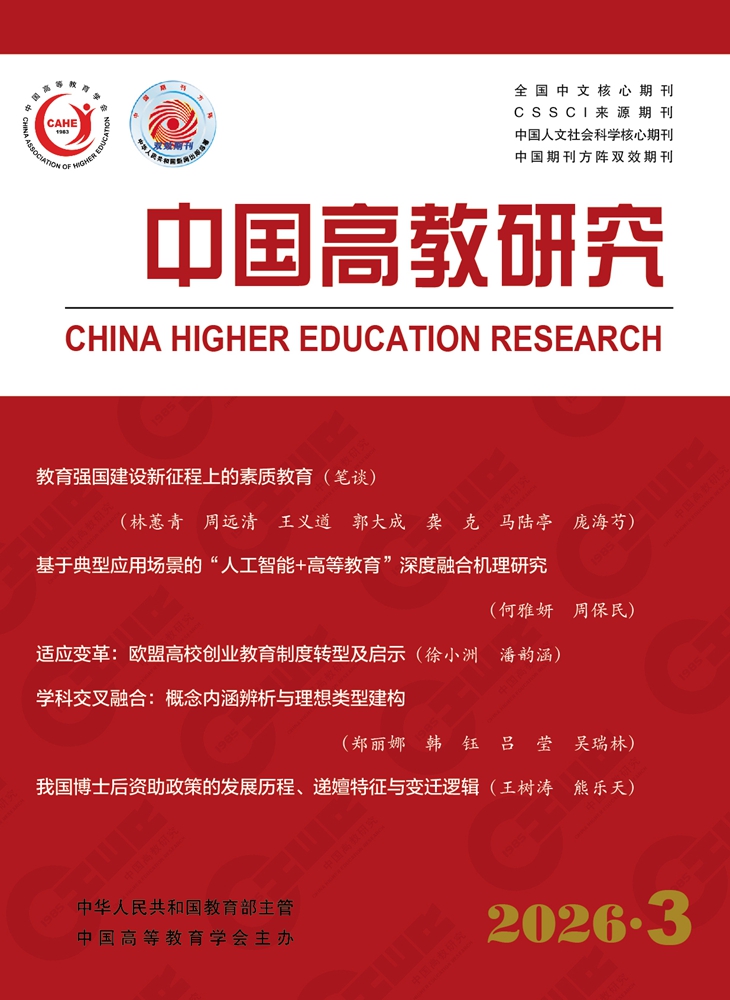
    LIN Huiqing; ZHOU Yuanqing; WANG Yiqiu; GUO Dacheng; GONG Ke; MA Luting; PANG Haishao
    Abstract ( )   Knowledge map   Save
  • Building a Leading Country in Education
    XUAN Yong1,2; YANG Kailiang1
    Abstract ( )   Knowledge map   Save
    Discourse analysis based on the academic interview corpus can examine core topic areas of discourse. The discourse comparison between different cultures may identify or even reveal deep commonalities and differences. By using NVivo 15 software, discourse analysis towards the book Looking Back:University Presidents’ Dictations and the book Tradition and Innovation: Dialogues with Presidents of First-Class American Universities which are built as a corpus is conducted. From the result of Spearman’s rank correlation coefficient, it can be seen that the common hot words involved has strong similarity, but the differences reflected by non-common hot words are also significant. Based on the discourse analysis framework of James Paul Gee, linguistic analysis and critical discourse analysis are conducted on three coding nodes namely “problem/question” “cooperation” and “development”. Through the analysis of specific discourse, the core differences are manifested in the role positioning, value pursuit and strategic choice of Chinese and American university presidents. The reasons possibly lie in the differences of interview forms, president selection methods, the historical culture, political and economic system and development stages of the university. Stage-specific differences between Chinese and American universities give us the enlightenment that for the purpose of building a powerful country in higher education, universities should firstly follow the school running universal laws and carve out the unique Chinese path, secondly grasp the characteristics of the stages and focus on connotative development, and finally promote classified evaluation and carry out effective governance.
  • The Development of Artificial Intelligence in Higher Education Institutions
  • The Development of Artificial Intelligence in Higher Education Institutions
    HE Yayan1; ZHOU Baomin2
    Abstract ( )   Knowledge map   Save
    Against the backdrop of the deep advancement of education digitalization strategies, revealing the intrinsic mechanisms of the deep integration of artificial intelligence and higher education is essential for building a high-quality intelligent education ecosystem. Based on STS theory and the TOE framework, this study extracts five conditional variables: technological autonomy, leadership impetus, organizational synergy, application coverage, and ecological openness, while classifying integration levels according to the SAMR model. By employing fsQCA on 53 “AI + Higher Education” typical application scenarios recognized by the Ministry of Education, this paper explores the causal mechanisms driving the digital transformation of higher education. The findings indicate that the six configurations generally follow two modes: “Organization-Driven Transformation” and “Technology-Ecology Symbiosis”. Accordingly, it is proposed to establish a top-level strategy of mutual construction between organizational change and technological empowerment, build a borderless and open intelligent landscape, and precisely match transformation pathways based on resource endowments, so as to construct a high-quality intelligent education ecosystem featuring human-machine collaboration, co-creation, and sharing.
  • The Development of Artificial Intelligence in Higher Education Institutions
    SHAO Honghong
    Abstract ( )   Knowledge map   Save
    AI-generated theses are deemed the applicant’s independently completed work under copyright law but regarded as ghostwriting research misconduct in higher education, creating a coherence interpretation dilemma. Labeling prompt?based AI thesis writing as ghostwriting fails to satisfy its constituent elements and systematic interpretation under academic norms. The divergence in originality standard between copyright law and academic norms forms the logical basis for identifying research misconduct in AI-generated theses. A dual-layer framework of “content-behavior” should be adopted: at the content level, existing academic research misconduct categories should apply to risks of fabrication, falsification, and plagiarism, with human authors bearing strict liability; at the behavior level, new misconduct categories should be established based on mandatory AI usage disclosure obligations.
  • Comparative Education
  • Comparative Education
    XU Xiaozhou; PAN Yunhan
    Abstract ( )   Knowledge map   Save
    Since the early 21st century, in response to the challenges of globalization and socio-economic transformations, the European Union (EU) has actively promoted the institutional transformation of entrepreneurship education in higher education institutions from a spontaneous, selective and fragmented approach to an organized, universal and standardized model. From a broad perspective, economic and technological changes have driven shifts in educational philosophies and institutional arrangements. Through continuous adjustments to the positioning, objectives, and competence frameworks of entrepreneurship education, the European Commission has developed a multi-level, networked, and systemic framework. Overall, this restructuring is characterized by a focus on key priorities, the removal of structural bottlenecks, and the strengthening of institutional support mechanisms.During this process, higher education institutions have advanced educational approaches, training models, and quality assurance practices, enhancing talent development through integrated entrepreneurship education ecosystems. Drawing on the EU’s experience, this paper suggests that China may consider deepening organizational restructuring, establish a coordinated entrepreneurship competence framework, and strengthen faculty professional development. It further suggests enhancing innovation capacity and promoting knowledge transfer. These efforts aim to support high-quality entrepreneurship education aligned with the goals of building a modern socialist country.
  • Comparative Education
    MA Jiansheng; BAI Zhiyong
    Abstract ( )   Knowledge map   Save
    As global technological competition intensifies and the geography of innovation is reshaped, integrating universities into regional innovation system building has become a key national strategic priority. The U.S. National Science Foundation’s Regional Innovation Engines (RIE) program offers a salient reference for examining the underlying logic and practical pathways of university integration. The strategic pillars of “use-inspired R&D”“innovation transfer” and “workforce development” underpin the integration of U.S. universities into regional systems. Within this framework, U.S. universities continuously integrate into and advance regional innovation systems by building applied research-oriented collaborative innovation networks; leveraging their anchoring role and fostering open innovation ecosystems; and establishing multi-tiered, differentiated workforce development systems. Looking ahead, enabling Chinese universities to better integrate into regional innovation systems will require re-positioning their functional roles, optimizing pathways for research commercialization, and reforming talent cultivation mechanisms.
  • Disciplinary Construction
  • Disciplinary Construction
    ZHENG Lina1; HAN Yu2; LU Ying2; WU Ruilin2
    Abstract ( )   Knowledge map   Save
    Interdisciplinary integration has emerged as a critical imperative for technological innovation and talent cultivation. Grounded in the dual logic of knowledge boundaries and control inherent in disciplines, this study employs Basil Bernstein’s concepts of classification and framing to deconstruct the dynamics of integration. The analysis reveals that interdisciplinary practice entails a structural shift from “strong” to “weak” classification—signifying increased permeability across disciplinary borders—and a transition from “strong” to “weak” framing, reflecting a diversification of control over knowledge production. Based on these dimensions, four ideal types are proposed: institutionalized multidisciplinary coordination, spontaneous multidisciplinary cooperation, institutionalized fusion innovation, and emergent frontier exploration. It reveals the evolutionary logic of Interdisciplinary integration, moving from a simple combination to a deep collaborative creation. The study concludes that advancing interdisciplinary integration requires not the dissolution of existing disciplines, but the navigation of the embedded agency paradox, thereby sustaining a productive tension between institutional stability and epistemological innovation.
  • Disciplinary Construction
    HE Yuanhao1; XU Haotian1; WU Jiaqi2
    Abstract ( )   Knowledge map   Save
    Optimizing the disciplinary structure of higher education constitutes a critical foundation for high-quality economic growth. This study develops an endogenous growth framework that incorporates both substitution and complementarity mechanisms across disciplines, using the cross-country panel data from 2000 to 2018. The results reveal heterogeneity in marginal growth effects: engineering generates a short-run stimulus, natural sciences exert a persistent long-run effect, while social sciences contribute indirectly through complementary coordination. Economic growth is driven primarily by cross-disciplinary complementarities, and a balanced and synergistic disciplinary structure provides robust support for growth, particularly as higher education systems expand toward universal access. These findings refine the theoretical understanding of the relationship between higher education and economic growth and provide empirical insights for optimizing disciplinary structure in China.
  • Modernization of Higher Education Governance
  • Modernization of Higher Education Governance
    WANG Shutao; XIONG Letian
    Abstract ( )   Knowledge map   Save
    Postdoctoral fellows are a strategic force in promoting the construction of an educational and technological powerhouse. Based on the analysis of policy documents, academic literature, official reports, and other materials, from the perspective of historical institutionalism, it is believed that since the establishment and implementation of China’s postdoctoral system in 1985, the postdoctoral funding policy has gone through the elite funding stage under national unified funding (1985-1992), the diversified funding stage under scale expansion (1993-2007), the strategic precision funding stage under quality orientation (2008-2015), and the diversified collaborative funding stage under system reconstruction (2016 to present). The policy function has shifted from emergency talent supplementation to serving the national innovation strategy, resource allocation has shifted from planned supply to performance incentives, the governance system has shifted from national monopoly to central, local, unit and social co governance, and the value concept has shifted from affairs management to supporting career development. Further research will reveal the logic of policy changes from macro level deep structure, meso level path dependence, and micro level dynamic mechanisms. In the future, we should strengthen the guidance of central finance, establish a tiered and precise funding system, and strengthen the institutional support for the career development of postdoctoral fellows, in order to promote the high-quality development of postdoctoral funding policies.
  • Modernization of Higher Education Governance
    QING Can; ZHU Junwen
    Abstract ( )   Knowledge map   Save
    Teacher mobility is a continuous hot topic in the research of the teaching staff in colleges and universities. Based on the background of the personnel system reform in colleges and universities with the tenure and tenure-track system as the main orientation, this study focuses on the relationship between the changes in the appointment system and the mobility of college teachers, and attempts to analyze the new characteristics of the mobility of college teachers using new evidence. The study employed the resume analysis method and took 26 346 teachers from 27 universities as samples. Through empirical research, it was found that the overall scale of teacher mobility in China’s universities has been on the rise; In the stage of the tenure and tenure-track system reform, the frequency of teacher mobility has reached a new high, the number of mobility for young teachers has increased, the mobility cycle of young teachers was significantly shortened, and the average mobility cycle of teachers was highly consistent with the appointment and assessment cycle. Based on this, it is also found that the reform of the pre-appointment - tenure-track system presents the characteristics of high competition and strong screening. The regulatory role of the appointment and assessment cycle on the mobility cycle of teachers; There is a conflict between the stability and long-term nature of teachers’academic careers and the increasing trend of teachers’mobility.
  • Curriculum and Teaching Reform
  • Curriculum and Teaching Reform
    LIU Yanhong1; YANG Jie2; LIU Shuangyang1
    Abstract ( )   Knowledge map   Save
    Under the background of digital transformation of education, the teaching materials of law major need to break through the limitations of traditional paper forms, and promote the construction of new forms of teaching materials supported by digital intelligence technology, integrating digital resources, online interactive platforms and data analysis tools. At present, the construction of new forms of teaching materials for law majors is faced with multiple difficulties, such as insufficient fit between content setting and the goal of cultivating legal talents, disconnection between functional design and user learning experience, and incompatibility between teaching material form and traditional publishing mode. In this regard, we should establish the construction concept with “interaction” as the core, give full play to the key functions of new forms of teaching materials as the carrier of human-computer interaction and interpersonal interaction, and promote the integration of legal knowledge teaching and ability cultivation. Focusing on the realization of interactive functions, it is necessary to strengthen the development of interactive teaching resources, optimize the design of interactive teaching programs, and improve the interactive learning effectiveness evaluation system.
  • Documentation
  • Documentation
    China Association of Higher Education
    2026, 42(3): 101-108.
    Abstract ( )   Knowledge map   Save