Current Issue

  • Select all
    |
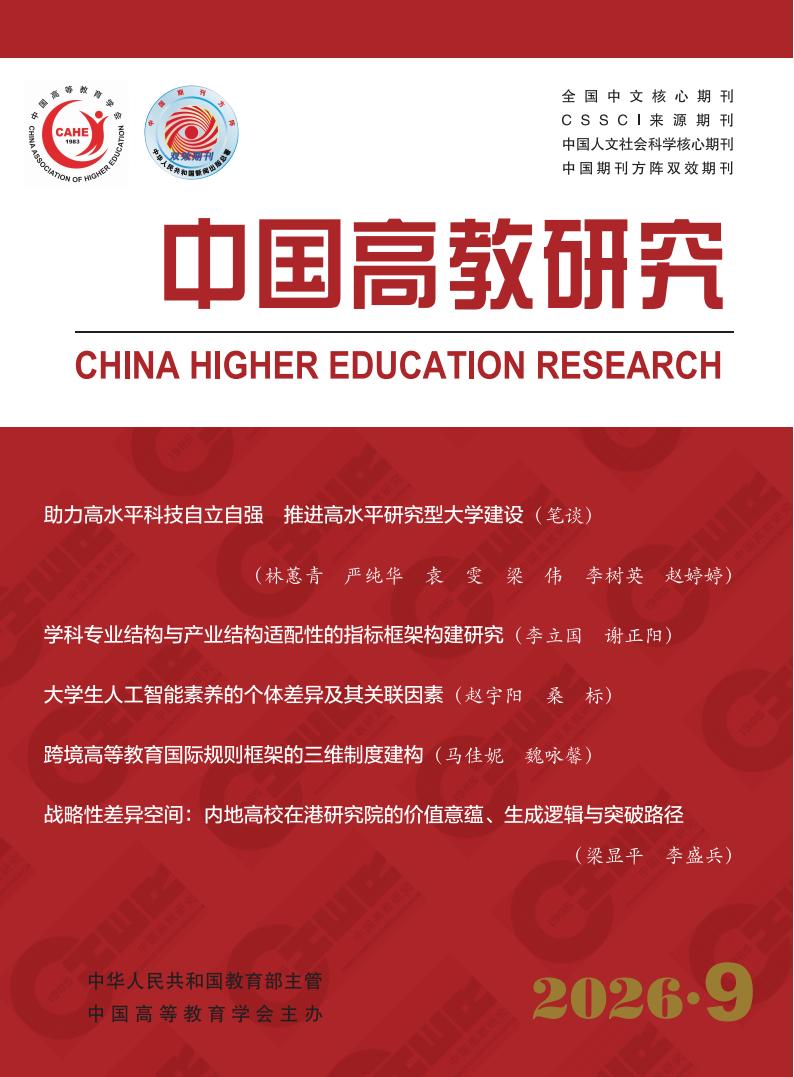
    Building a Leading Country in Education
  • Building a Leading Country in Education
    LIN Huiqing; YAN Chunhua; YUAN Wen; LIANG Wei; LI Shuying; ZHAO Tingting
    Abstract ( )   Knowledge map   Save
  • Disciplinary Construction
  • Disciplinary Construction
    LI Liguo; XIE Zhengyang
    Abstract ( )   Knowledge map   Save
    The adaptability of discipline structure and industrial structure is the key for higher education to support high-quality economic and social development and improve its contribution ability. Due to the different classification logic between industry and discipline, it is difficult to measure the adaptability directly. By integrating theories of human capital, industrial chain and task model, the industrial categories are grouped into six functional types according to the functional orientation of industrial chain, and then divided into five industries according to patent density and per capita output value: innovation-driven high-efficiency, capital operation high-output, technology application support, labor absorption service and public service guarantee, and the mapping relationship between industry and discipline is established through core task types. On this basis, a theoretical framework of adaptability including three core dimensions of category structure, hierarchical structure and spatial structure and four auxiliary dimensions of policy adaptation, scale adaptation, quality adaptation and guarantee adaptation is constructed, and an index system is given. This framework provides theoretical basis and practical tools for the dynamic adjustment of discipline and major structure.
  • Disciplinary Construction
    WANG Yiliang
    Abstract ( )   Knowledge map   Save
    At present, there is a clear block in the structural adaptation between the supply of professional talents in higher education disciplines and the demand of the labor market in China. The “difficult employment” of graduates and the “difficult introduction” of employers coexist. Based on the theory of educational matching, a “quantity-quality” two-dimensional analysis framework and a “signal-response-feedback” conduction model are constructed to examine the impact of the triple logic of the state, the market and academic organizations on the adjustment of disciplines and specialties. The structural mismatch is not only reflected in the quantity deviation of talent scale, professional distribution and job demand, but also in the quality disconnection between training content and job skill requirements. The lag of specialty adjustment is related to the attenuation of demand signal transmission and the rigidity of catalogue management, and is also restricted by the bias of scientific research evaluation and the game of interests in the school. The feedback fracture between enrollment, training and employment further weakens the correction ability. There are differences in mismatch forms at different educational levels. We should improve dynamic monitoring and early warning, promote hierarchical classification linkage adjustment, and improve the feedback mechanism of enrollment, training and employment.
  • The Independent Knowledge System of Chinese Education
  • The Independent Knowledge System of Chinese Education
    JI Wenxi
    Abstract ( )   Knowledge map   Save
    Constructing an autonomous knowledge system of Chinese pedagogy is a profound theoretical imperative for advancing the construction of a leading country in education. This process inherently follows a mutually constitutive logic characterized by bidirectional empowerment and synergistic coexistence between the two, embodied in the operational pathway of “theoretical guidance-practical drive-systemic empowerment”. First, as the theoretical cornerstone of a leading country in education, the autonomous knowledge system is committed to developing indigenous original theories and establishing an analytical paradigm of “Chinese problems-Chinese methods-Chinese solutions”, thereby reversing the reliance on Western theories. Second, building a leading country in education serves as the practical driver for knowledge system innovation, where practical challenges compel theoretical breakthroughs, and the comparative advantages of Chinese education provide empirical support for theoretical development. Finally, the two should achieve bidirectional synergistic development through the “three-in-one” construction of disciplinary system, academic system, and discourse system. The autonomous knowledge system constitutes the core of the “soft power” of a strong educational nation, and the absence of either would render the endeavor unsustainable. Therefore, it is imperative to advance the construction of the autonomous knowledge system in alignment with the goal of building a leading country in education, fostering a virtuous cycle of “strong nation leadership-knowledge innovation-cultural prosperity” through bidirectional empowerment, and ultimately realizing the autonomous rise of Chinese pedagogy.
  • Cultivating Talents
  • Cultivating Talents
    ZHAO Yuyang1; SANG Biao2
    Abstract ( )   Knowledge map   Save
    As generative artificial intelligence becomes embedded in higher education, individual differences in college students’ artificial intelligence literacy warrant attention. Using survey data from 1,364 college students, this study employed structural equation modeling to examine associations among life satisfaction, the overall importance attached to career-decision factors, creative growth mindset, and artificial intelligence literacy, while controlling for demographic, educational-stage, institutional, and disciplinary factors. Life satisfaction, the overall importance attached to career decision factors, and creative growth mindset were positively associated with artificial intelligence literacy; the first two were also positively associated with creative growth mindset. Both statistical indirect associations were significant, and the findings remained stable across alternative specifications. The results indicate that artificial intelligence literacy is associated with students’ current subjective evaluation of life, the importance they attach to career decision factors, and beliefs in the malleability of creativity. Because the data are cross-sectional and same-source self-reports, temporal ordering, causal direction, and mediation require further investigation.
  • Cultivating Talents
    SUN Chiyao; LU Yi; MA Ying
    Abstract ( )   Knowledge map   Save
    The cultivation of top-notch innovative talents is a central proposition running through China’s modernization. Since 1978, relevant policies have reflected a complex interplay between the state’s strategic objectives and the education system’s tactical responses. Drawing upon a “strategic–tactical” framework grounded in historical institutionalism, this study periodizes these policies into six phases, elucidating the logic of “contextual background–strategic considerations–tactical responses” in each. It further dissects three challenges in the systemic reconstruction: the structural configuration of education, the paradigm of talent nurturing, and the logic of governance, aiming to provide historical insights for China’s transition from a “country rich in human resources” to a “talent-strong country”.
  • Internationalization of Higher Education
  • Internationalization of Higher Education
    MA Jiani; WEI Yongxin
    Abstract ( )   Knowledge map   Save
    Against the backdrop of China’s strategy to expand high-level opening up in education, international rules constitute an important institutional foundation for regulating cooperation in cross-border higher education and participating in global education governance. Drawing on 25 international rule documents on cross-border higher education issued by international organizations, sovereign states, and non-governmental organizations, this study conducts a textual analysis based on Scott’s three-pillar theory of institutions. The findings show that the international rules governing cross-border higher education form a three-dimensional framework comprising the balancing of governance tensions, the building of institutional trust, and the construction of cross-domain consensus. These three dimensions correspond respectively to the constraining and regulatory mechanism of the regulative pillar, the value-guiding mechanism of the normative pillar, and the meaning-making mechanism of the cultural-cognitive pillar. The existing international rules framework still faces several limitations, including regulatory gaps concerning emerging forms of cross-border education, fragmentation of quality assurance standards, questions about the effectiveness of degree recognition systems, and limited enforceability of the international rules system. Accordingly, China’s participation in the global governance of cross-border education should progressively move from rule alignment toward institutional innovation and the co-construction of international rules.
  • Internationalization of Higher Education
    LUO Qing1; HAO Xudong1; JI Xuanyu2
    Abstract ( )   Knowledge map   Save
    Promoting reform through opening-up is the inevitable path for the reform and development of higher education in China. As a critical pathway driving educational reform and innovation, the mechanism of Internationalization at Home (IaH) has not yet been fully elucidated. Based on the innovation ecosystem perspective, this study adopts an exploratory multi-case research method, using representative cases of Sino-foreign cooperative education as examples to explore the systematic mechanism and dynamic evolution model of Internationalization at Home driving comprehensive higher education reform, and to reveal the systematic characteristics across different reform stages. This study finds that the comprehensive reform driven by Internationalization at Home follows an evolutionary trajectory consisting of three phases: the introduction of openness, practical implementation, and outcome sublimation. It also reveals the functional logic underlying the embedding of local resources, the restructuring of relational structures, and the generation of pluralistic values.
  • Internationalization of Higher Education
    LIU Qian; SUN Qianxiang; LIU Qingjie
    Abstract ( )   Knowledge map   Save
    Scholarships for international students in China are an important component of China’s higher education opening-up, playing a positive role in supporting international students’ study in China and promoting international educational exchange and intercultural understanding. Based on survey data from 2,098 international students in China, this study examines the impact of the scholarship policy on international students’ perceptions of China and its underlying mechanisms. The findings reveal that the scholarship policy significantly promotes international students’ positive perceptions of China. Scholarship recipients report higher levels of study satisfaction and stronger identification with the mutual-benefit nature of the Belt and Road Initiative, which in turn reinforces their positive perceptions of China. Moreover, the positive effects are more pronounced among female students, those who received pre-departure training, and those with prior international experience. The effects of the scholarship exhibit a diminishing gradient across dimensions, from macro-policy perceptions, to daily life experiences, to cultural identification. These findings provide empirical evidence from the perspective of perceptions of China that the scholarship policy for international students in China has positive educational effectiveness.
  • Research and Exploration
  • Research and Exploration
    LIANG Xianping; LI Shengbing
    Abstract ( )   Knowledge map   Save
    The establishment of research institutes in Hong Kong by mainland universities represents a novel experiment in cross-border higher education spatial production under the “One Country, Two Systems”framework. This article conceptualizes these institutes as “strategic differential spaces” and employs the “materiality, imagining and social practice” triad from spatial production theory to systematically analyze their inherent logic of spatial generation. The formation of these spaces is rooted in the structural transformation of global knowledge production and the strategic integration of multiple scales. Yet, operating within Hong Kong’s highly legalized and market-driven environment, they confront institutional frictions, including impeded cross-border flows of personnel, funding, and equipment, as well as conflicts in evaluative frameworks and governance cultures. In response, actors continuously reshape the boundaries and operational logics of these spaces through organizational restructuring, hybrid governance, and discursive adaptation. However, the enduring constraints of institutional identity ambiguity and resource dependency continue to impede their sustainable development. Moving forward, it is imperative to establish cross-border institutional articulation mechanisms and deepen their embeddedness in Hong Kong’s local innovation ecosystem, so as to fully actualize their strategic potential.
  • Research and Exploration
    HONG Min; ZHANG Jiahui
    Abstract ( )   Knowledge map   Save
    What talent titles accomplish depends on the stages at which, and the rules under which, institutional recognition is redeemed for disposable resources. Drawing on Bourdieu’s theory of capital conversion and interviews with 18 early-career returnee academics, this study follows three channels, namely title redemption, organisational embedding and competitive application. The rate at which titles are converted declines across three stages. At the point of entry, the university binds rank, funding and contract review through formal rules in a single act, and the trigger does not necessarily lie in the title. At the discretionary stage quotas and space are settled case by case by schools, and titles of the same level are redeemed to markedly different degrees. At the competitive stage titles do not enter the basis of allocation. A faculty member’s resource position depends on the combination of access across the channels; holding a title is not a sufficient condition for the differentiation of resources, and titles largely confirm accumulation already achieved. Reform should therefore address the rules of conversion themselves, unbinding the entry package from the title and bringing discretionary redemption under public rules.
  • Research and Exploration
    LI Fenglei
    Abstract ( )   Knowledge map   Save
    Some research teams in Chinese higher education institutions exhibited a distinctive pattern of “structural introduction with institutional absence” when transplanting the Principal Investigator (PI) system; yet their informal academic guidance orders, despite harboring underlying disorderly crises, functioned stably over an extended period, posing an empirical challenge to the assumption that “without formal institutions, order is difficult to sustain”. While the New Institutionalism paradigm centered on the analysis of“rules”has already incorporated informal constraints and cultural-cognitive elements, its analytical logic still tends to reduce governance mechanisms to some form of rules. This paper introduces Fei Xiaotong’s “Differentiated Sequence Pattern” theory, distills the concept of “Differentiated Reciprocity”, and reveals three distinct pathways through which a differentiated value logic gives rise to an order: laying the foundation for expectations through the identification of social layers, defining behavioral boundaries through the existence or demise of identities, and accommodating gaps in friction through temporal extension. The value consensus based on proximity and reciprocal cycles can sustain cooperation independently of formal rules, endowing the order with resilience along the “Value-Identity-Time”axis.